
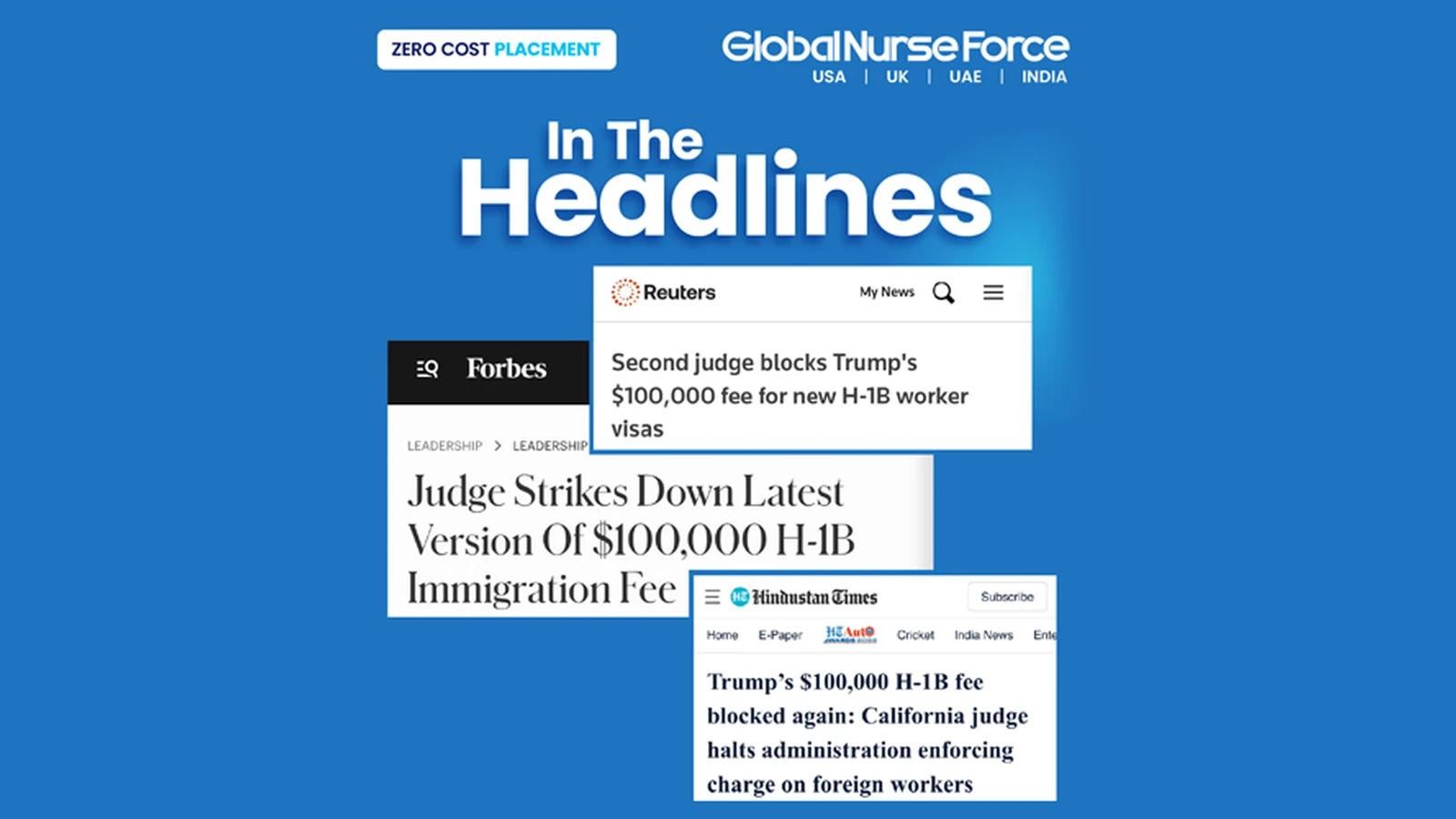
On September 30, 2026, a U.S. federal judge ordered U.S. immigration agencies to stop enforcing the rules they used to collect the $100,000 payment (often called the $100,000 H-1B visa fee) for certain new H-1B workers. The order came in Global Nurse Force v. Trump, a lawsuit led by Global Nurse Force, an international nurse recruitment company based in California.
What this means today: for affected H-1B cases, employers do not have to pay the $100,000 payment at this time. Nurses were never expected to pay it.
What has not changed: this is not the final decision. The order is temporary, the case is still going on, and the government may appeal. This could change if the court orders are changed or lifted.
Here are the major points about the case and the latest update that international nurses should be aware of.
A major development in Global Nurse Force v. Trump
President Trump issued the original proclamation on September 19, 2025. It required a $100,000 payment for certain H-1B cases and took effect on September 21, 2025. On September 18, 2026, he extended it for another year, through September 21, 2027. The September 30 court order covers this extension too.
Global Nurse Force leads the case with a coalition of healthcare providers, schools, labor organizations and others. That is why many people call it the Global Nurse Force H-1B visa case. The ruling is an important step for employers and international professionals. But it is a preliminary ruling, and the case is still ongoing.
What the ruling means for international nurses
- No $100,000 payment for now. For affected cases, employers do not have to pay it at this time. Court orders stop U.S. agencies from collecting it.
- Nurses never paid for it. It was always the employer’s cost.
- Employers can look at their H-1B plans again while the court orders stay in place. But the ruling does not guarantee that a particular nurse or job qualifies for H-1B.
- No automatic visa or job. You still need an eligible job, an employer who will sponsor you, and approval through the right immigration process.
- EB-3 and TN were not part of this payment. They have their own rules. TN is only for qualifying Canadian and Mexican professionals.
What did the court decide?
Judge Haywood S. Gilliam Jr. of the U.S. District Court for the Northern District of California granted part of what the plaintiffs (the groups that sued) asked for.
He gave a preliminary injunction. This is a temporary court order made while a case is still going on.
The court determined that the plaintiffs had a reasonable chance of prevailing on certain claims brought under the Administrative Procedure Act (APA). The APA is the law that tells U.S. government agencies how they must make new rules.
What the court ordered:
- It cancelled the agency policies used to collect the payment. The legal word for this is “vacated”.
- The agencies cannot use those policies again until they follow the proper steps first. These steps are called public rulemaking (asking the public for comments) and regulatory analysis (studying the rule’s impact).
- The order covers both the September 2025 proclamation and the September 2026 extension.
What the court did not decide:
- The President’s power. The judge has not made a final decision on whether the President had the authority to issue the proclamation.
- A nationwide class. The court did not turn the case into a class action for all employers in the country. It said this was not needed to give the temporary order.
Why Global Nurse Force led the case
The lawsuit was filed by a coalition, with Global Nurse Force as the lead plaintiff. Five of the plaintiffs asked the court for the order that was granted on 30 September 2026.
When the payment was announced, Global Nurse Force was helping a Louisiana health system prepare H-1B petitions for more than 200 nurses. At $100,000 for each affected petition, the potential payment for that group alone would have exceeded $20 million.
Court filings also described healthcare employers pausing plans to recruit specialized professionals. The coalition argued that the payment could prevent hospitals and other organizations from hiring people they needed to serve their communities.
“As lead plaintiff in this challenge, Global Nurse Force stood up because this $100,000 fee was already forcing hospitals to pause recruitment of urgently needed healthcare professionals and putting patient care at risk,” said Lalit Pattanaik, CEO of Global Nurse Force. “This ruling is a victory for America’s health systems, international nurses and doctors, and the communities that depend on them. We will continue fighting for fair, workable immigration pathways that strengthen our nation’s healthcare workforce.”
The coalition also issued this joint statement:
“This decision protects patients, students, workers, and communities across the country from an unlawful and arbitrary fee that Congress never authorized. This administration’s Innovation Ban threatened to shut out doctors from rural hospitals, teachers from classrooms, engineers from job sites, and clergy from congregations. The court’s ruling reaffirms a basic principle: agencies cannot demand payment of arbitrary fees just because the president says so.”
What this does and does not mean for nurses
The court order removes the $100,000 cost barrier while it remains in force. This is good news for the H-1B visa for nurses. But the order does not make every nursing job eligible for H-1B sponsorship. Eligibility depends on what the job needs and on the nurse’s qualifications. Having the title “registered nurse” does not guarantee that a job qualifies.
Also, getting a visa and getting a nursing license are two separate processes. Depending on your situation and the U.S. state where you plan to work, you may need:
- A state nursing license
- A review of your nursing qualifications (credential review)
- An English-language test
- The NCLEX-RN exam
- Other requirements
Was your hiring or visa process paused? Contact your future employer or your recruitment consultant to review your case. Your next steps depend on your job, your visa route and your own situation.
Timeline: Global Nurse Force v. Trump so far
| Date | What happened |
|---|---|
| September 19, 2025 | President Trump signs the proclamation requiring the $100,000 payment |
| September 21, 2025 | The payment rule starts |
| October 3, 2025 | Global Nurse Force v. Trump is filed in California. It is the first lawsuit against the payment |
| October 16, 2025 | A second lawsuit was brought in Washington, D.C. by the U.S. Chamber of Commerce, together with the Association of American Universities. |
| December 12, 2025 | Twenty U.S. states, led by California, file a third lawsuit in Massachusetts |
| December 18, 2025 | The Global Nurse Force coalition asks the court for a preliminary injunction |
| December 23, 2025 | Judge Beryl A. Howell in Washington, D.C. rules for the government |
| June 8, 2026 | Judge Leo T. Sorokin in Massachusetts cancels the payment policy in the states’ case |
| July 24, 2026 | The First Circuit appeals court refuses to pause the Massachusetts ruling |
| August 25, 2026 | DHS proposes a separate $103,265 fee for certain H-1B petitions |
| September 18, 2026 | The proclamation is extended until September 21, 2027 |
| September 30, 2026 | Judge Haywood S. Gilliam Jr. grants part of the preliminary injunction in Global Nurse Force v. Trump |
What happens next?
The case continues. As of October 14, 2026, here is what is scheduled:
- October 20, 2026: Both sides are due to send the court a joint status report (a shared update on the case).
- October 27, 2026: The court is scheduled to hold a case management conference (a meeting to plan the next steps).
- Possible appeal: The government may ask a higher court, the Ninth Circuit Court of Appeals, to review the order.
A separate new fee has also been proposed. On August 25, 2026, the Department of Homeland Security proposed a $103,265 fee for certain H-1B petitions that count toward the yearly H-1B limit (called the “annual cap”). This proposal is not yet in effect, and the September 30 order did not cover it.
Frequently asked questions
What is Global Nurse Force v. Trump?
Global Nurse Force v. Trump is a U.S. federal lawsuit. It was filed on October 3, 2025, in the Northern District of California. It challenges the $100,000 payment for certain H-1B cases. Global Nurse Force leads the case with healthcare providers, schools, labor groups and others.
What is the latest Global Nurse Force v. Trump update?
On September 30, 2026, Judge Haywood S. Gilliam Jr. approved some of the requests for a preliminary injunction. This means U.S. agencies cannot use the policies they made to collect the $100,000 payment until they follow the proper rulemaking steps. The case continues.
Do employers still have to pay the $100,000 H-1B visa fee?
Not at this time, for affected cases. Court orders currently stop U.S. agencies from collecting it. This could change if the court orders are changed or lifted.
Do nurses have to pay the H-1B visa fee?
No. The $100,000 payment was always the employer’s cost. Nurses were not expected to pay it.
Does this ruling mean I will get an H-1B visa?
No. The order does not grant a visa or a job. You still need an eligible job, an employer who will sponsor you, and approval through the right immigration process.
Are EB-3 and TN affected?
No. EB-3 and TN were not part of this H-1B payment. They have their own rules. TN is only for qualifying Canadian and Mexican professionals.
Can the $100,000 H-1B payment come back?
Yes. It could come back if a court changes or lifts the current orders, for example after an appeal. Also, DHS has proposed a separate $103,265 fee for certain H-1B petitions. That proposal is not in effect.
Did the court decide if the President had the power to create the payment?
No. The judge has not made a final decision on the President’s power. The ruling is about how the agencies put the payment in place, under the Administrative Procedure Act.
About Global Nurse Force
Global Nurse Force is an international nurse recruitment company headquartered in California, with offices in the United Kingdom, India and the United Arab Emirates. The company helps nurses secure rewarding careers across the globe so they can improve health for everyone, everywhere!
Follow Global Nurse Force’s H-1B lawsuit updates for developments in Global Nurse Force v. Trump.